



Remember when everyone was getting fired because of AI? Plot twist: the robots are still figuring out how to fill out expense reports.
The AI jobpocalypse got postponed indefinitely. Turns out, implementing AI is harder than buying it.
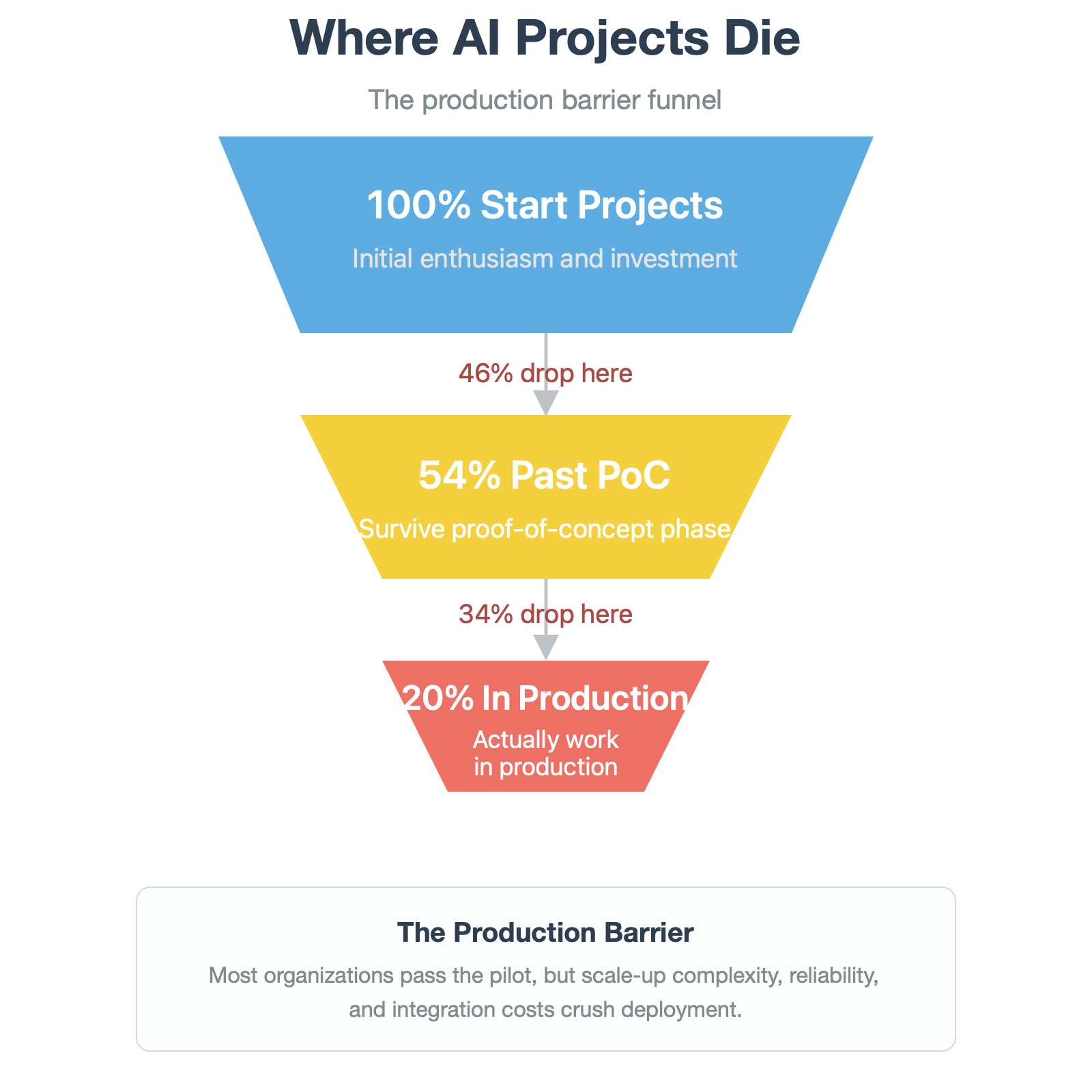
2024 was supposed to be the year AI replaced everyone. Instead, 42% of companies just gave up on most of their AI projects.
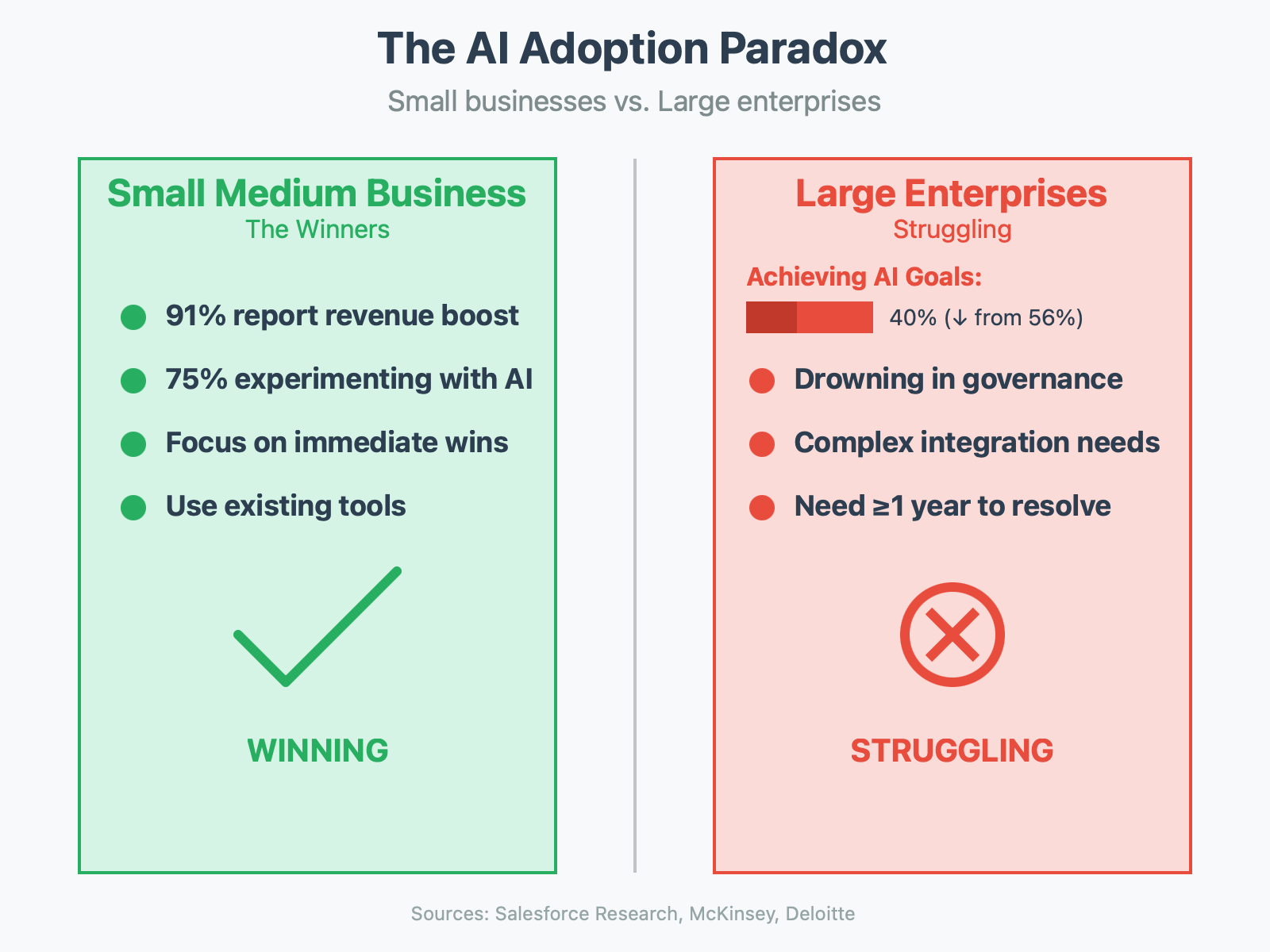
Here's what's actually happening: SMBs are beating enterprises to AI success - while big companies drown in governance committees, small businesses are getting 91% revenue boosts from AI tools they actually use.
But both are falling into the same traps. After helping multiple companies navigate AI implementation, here are the 4 critical mistakes I see everywhere:
1. The Tool Use Trap
Your AI can write poetry but can’t reliably fill out a form. This is the fundamental bottleneck – agents struggle with the entire chain: deciding IF they need a tool, picking the RIGHT tool, formatting parameters CORRECTLY, parsing output properly, and handling errors.
It’s like having a brilliant intern who freezes every time they need to use the printer. Every time you hand it a login page or a registration form, it freezes: oscillating between field names, tripping on validation errors, etc.
We have trained our AI to write about moonlit seas, but it falls apart when it has to click a “submit” button. This will not change, until we build a complete workflow—from spotting when a tool is needed, to formatting the right inputs, to API invocation, result checking, and error handling—this “clever assistant” will spend more time thinking than acting.
2. The Production Barrier
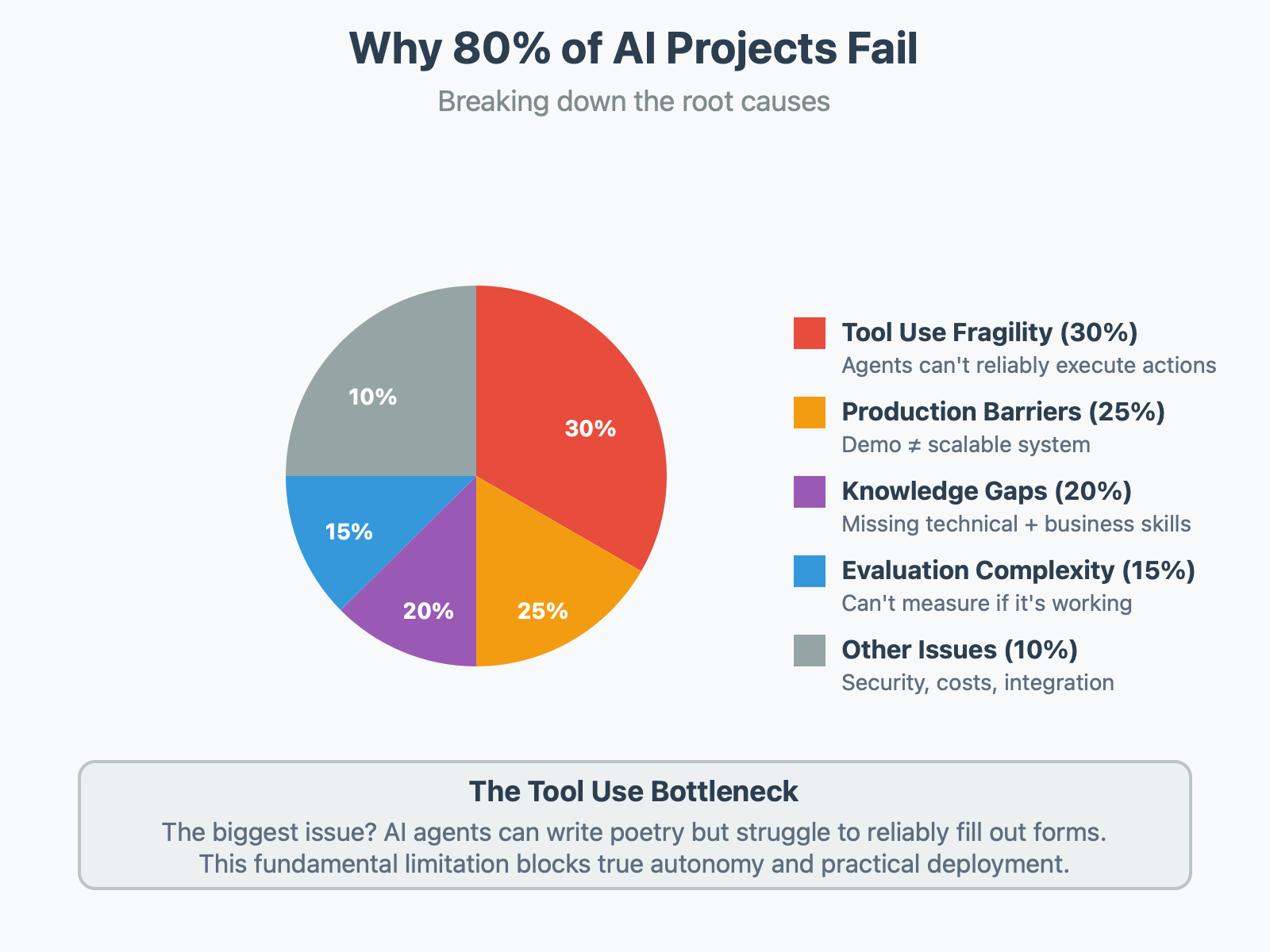
80% of AI projects fail because there's a systemic gap between “cool demo” and “actually works at scale.” The issues aren’t isolated – evaluation complexity makes reliability hard to measure, which makes costs unpredictable, which makes integration risky.
Most companies nail the pilot. Then reality hits. Suddenly, the tidy test data looks nothing like the messy streams of live information, and models start misbehaving in edge cases nobody expected. Teams realise they do not have clear benchmarks for success, so they argue over whether the system is “good enough.”
Meanwhile, maintenance costs increases as engineers tried to retrain models every time the underlying data shifts. Without solid monitoring in place, small errors slip through and cause big problems down the line.
In simple terms, you need more than just a fancy demo—you need real-world data pipelines, clear metrics, ongoing checks, and a plan for who’s in charge of keeping everything running.
3. The Low-Code Ceiling
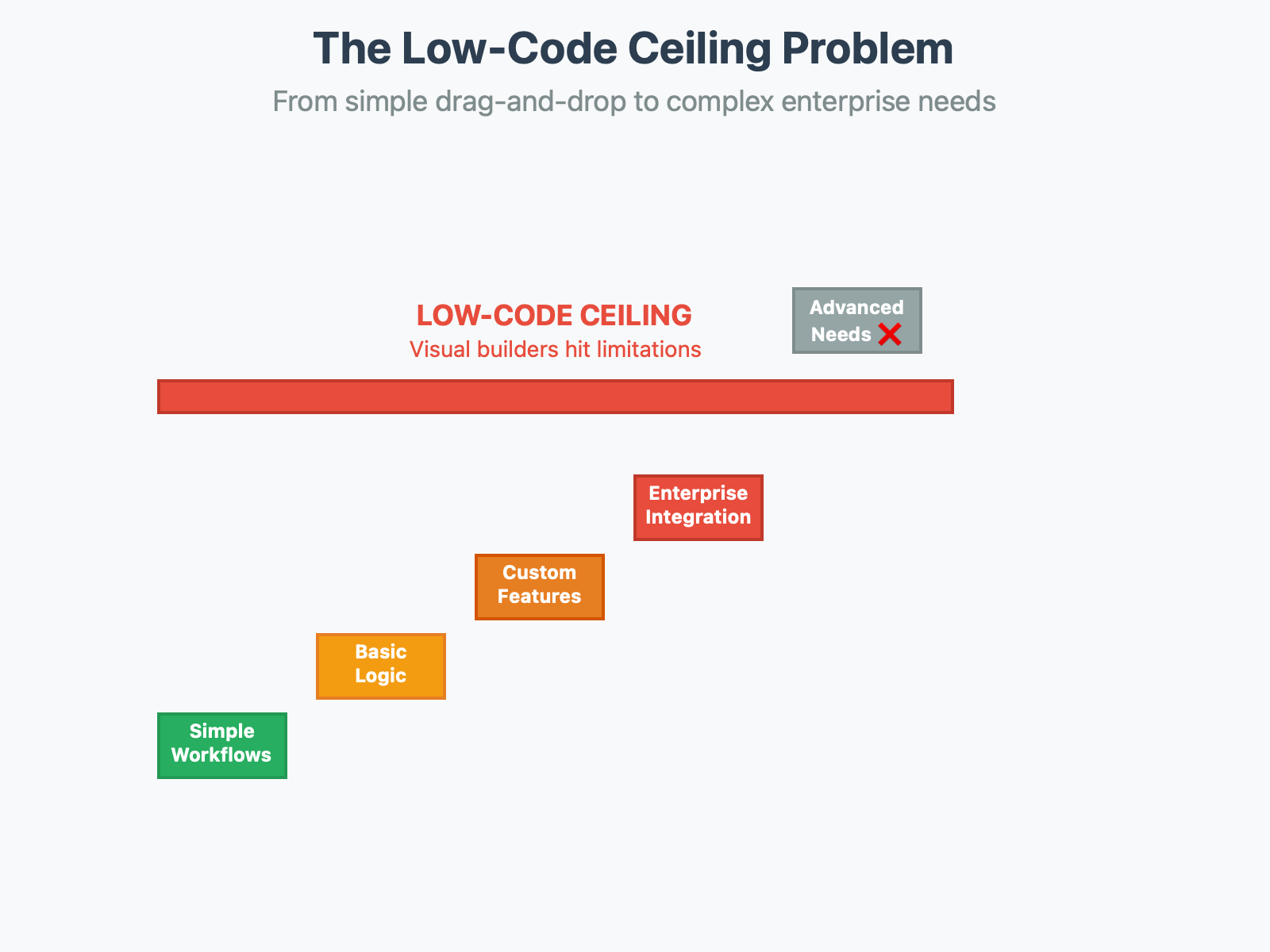
No-code and low-code platforms make it super easy to get started—just drag, drop, and you’re running in days. But large teams often hit a wall fast:
No-code platforms promise easy AI, but enterprises hit the ceiling fast. You start with drag-and-drop simplicity, then suddenly need custom logic, legacy system integration, or performance optimisation that the visual builder can't handle.
The numbers show this isn’t rare:
Gartner predicts 75% of new business apps will be built with low-code by 2026—yet 31% of enterprises say they never used low-code for their most critical apps because they ran into these limits.
One study found up to 39% duplicated code in large OutSystems projects, creating maintainability headaches unless you drop into code.
That’s why the best platforms offer an SDK “escape hatch”—a bridge from drag-and-drop simplicity to full coding power, so you can add custom logic, tune performance, or hook into any legacy system without starting over.
4. The Knowledge Gap (It's Not What You Think)
This isn't just about lacking Python skills for implementation. It's multidimensional: technical expertise (AI/ML theory, framework mastery), strategic understanding (use case selection, objective definition), domain knowledge, AND ethical awareness.
Companies fail when they have brilliant developers who don't understand the business problem, or business leaders who underestimate the technical complexity.
The Bottom Line: SMBs succeed because they focus on immediate productivity wins using existing tools. Enterprises get lost in complexity but have the resources to build properly - IF they understand these traps.
The companies winning? They start small, measure obsessively, and build production-ready systems from day one. Having written extensively about these implementation realities in production LLM applications, I can tell you: the difference between success and failure often comes down to treating AI as engineering, not magic.
If you’re ready to move past one-off experiments and embed AI as a true cross-functional capability, we're here to help. Whether you need a fresh set of eyes on your roadmap, hands-on support rolling out new models, or guidance setting up those all-important health checks and feedback loops, let’s talk. Feel free to contact Chelsea AI Venture—let’s turn your next AI pilot into a production tool.
Justin Ju
| AI Engineer at Chelsea AI Venture | justin@chelseaai.co.uk |
If you are interested in implementing AI solutions in your company, please subscribe to this channel. We will be sharing methodologies for implementing AI into business ideas and providing tech solutions to different problems.
At Chelsea AI Venture, we are offering services for scaling up AI in SMEs and we occasionally organise tech training events. Do not hesitate to contact me via email or by visiting our website for any questions or business cooperation opportunities.
Great!