



Large Language Models (LLMs) are sold on a promise of leverage: they let individuals do more, faster, with less friction. In software and knowledge work, the pitch is that AI collapses the cost of creation.
Yet, experienced practitioners are reporting a different reality. Instead of reducing total workload, LLMs often redistribute it—front-loading the easy work and back-loading the hard work. Projects start with explosive speed but stall near completion. Codebases grow rapidly, but stability creates a moving target.
This is not a paradox. It is a predictable outcome of applying probabilistic tools to deterministic problems without architectural guardrails. To understand why AI projects stall, we must move beyond how the work feels and examine the specific economic and cognitive mechanisms that drive this failure.
1. The Dopamine Trap: Hyperbolic Discounting in Workflow
The reason AI feels like magic at the start of a project but work at the end is rooted in the cognitive neuroscience of reward.
Humans are subject to hyperbolic discounting (or present bias). We systematically overvalue immediate rewards relative to future ones. In traditional workflows, the blank page presents a high initiation cost (activation energy). LLMs remove this barrier entirely. They provide an immediate, visible artifact: a draft, a script, a prototype.
To the brain’s dopaminergic system, this artifact registers as a Reward Prediction Error (a “better than expected” outcome). The immediate availability of the draft triggers a dopamine hit that feels like momentum. However, this signal is a distortion. The brain conflates output with outcome.
We accept the draft because the cost of verifying it, checking for bugs, hallucinations, or logic errors, is a future cost, which we heavily discount. We make a locally optimal decision to generate speed now, accepting an unpriced risk that accumulates as technical debt. The momentum users feel is often just the rapid accumulation of unverified complexity.
2. The Verification Tax: An Economic Reality
The shift from generation to evaluation is not just a change in cognitive mode; it is a fundamental shift in the economic structure of the task.
In the Green Zone (low stakes, high tolerance), AI offers genuine leverage. If an LLM drafts a marketing email, the cost of verification is low. If the output is wrong, the consequences are trivial.
In the Red Zone (high stakes, strict constraints), the math changes. Correctness here is binary. A single hallucinated legal clause or a race condition in code renders the entire artifact negative-value. Here, we encounter the Verification Tax:
If checking the work takes as long as doing the work, you have saved zero net time.
In agentic workflows, this tax is exponential. As an AI agent chains multiple steps together, the probability of a silent failure compounds. A system with 90% accuracy per step drops to ~53% reliability after just six steps (an illustrative decay rate that accelerates with complexity).
A common counter-argument is that agents will verify each other. This is a fallacy. Stochastic consensus is not verification. When two probabilistic models agree, they often share the same blind spots. Without an external source of truth, they merely converge on plausible nonsense.
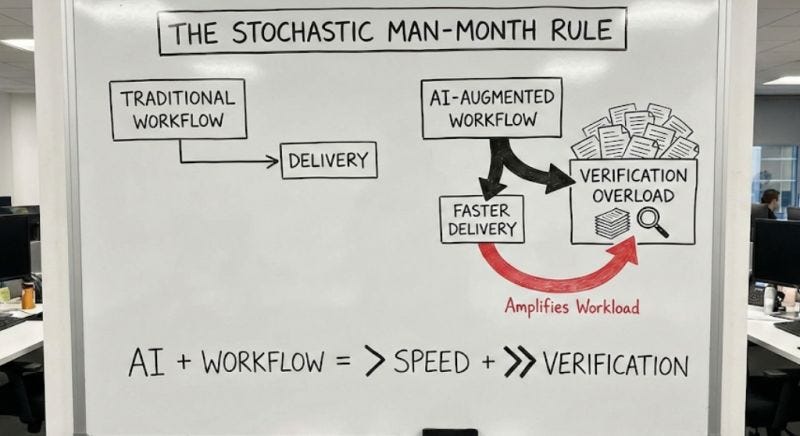
This dynamic updates Fred Brooks’ famous 1975 law (”Adding manpower to a late software project makes it later”) for the AI age. If you 10x your coding speed with AI, you won’t 10x your delivery speed. Code is easy; understanding is not (until some point in the future, where agents become the main actors). By accelerating code generation, you overload human attention.
Adding AI to a workflow amplifies the verification workload faster than it speeds delivery. Faster output creates more work, not less. (The Stochastic Man-Month Rule)
When the human enters the loop to fix this, they are not just editing. They are performing a forensic audit on a chain of reasoning they did not generate. This is often more cognitively expensive than doing the work from scratch. At this point, the tool is no longer augmenting judgment.
3. The Embodiment Gap: Why Judgment Cannot Be Delegated
Why is verification so hard? Why can’t the LLM just check itself?
The answer lies in Embodied Cognition and risk internalization. Human judgment is not merely the manipulation of abstract symbols; it is grounded in sensorimotor experience and social stakes.
A major counter-argument is that “humans make mistakes too.” This ignores a critical economic asymmetry: Humans have a loss function. We feel reputational risk, we fear firing, and we remember the pain of past failures. This embodied pressure forces humans to become more cautious when uncertainty rises.
LLMs have no such loss function. They do not “care” if they are wrong. They operate on the statistical likelihood of tokens, not the constraints of reality. They produce artifacts that are statistically impressive but semantically hollow. This hollowness is both a philosophical and an engineering problem. It means the model cannot distinguish between a creative variation and a catastrophic task failure.
The exhaustion users feel is the cognitive load of supplying this missing conscience. The human becomes the sole bearer of liability for a system that generates risk at machine speed.
The Green Zone Concession: Where Velocity Wins
This does not mean LLMs are useless. It means their utility is conditional.
In the Green Zone—where tasks are reversible, constraints are loose, and failures are loud—velocity dominates. Startups using AI to iterate on prototypes or generate boilerplate code will outpace those who don’t. In these contexts, the Verification Tax is negligible because the cost of failure is near zero.
However, we must define the Red Zone clearly: any task where correctness is binary, failure is silent, and consequences are delayed. In infrastructure, security, law, and core medicine, velocity is not the metric; trust is. No amount of model improvement solves the structural problem that probabilistic models cannot guarantee deterministic outcomes.
4. The Engineering Solution: Heuristics Over Heroics
The solution to this problem is not to “think harder” or “have more patience.” It is to treat intelligence as a cost to be managed. We need Complexity Gates to prevent stochastic tools from drifting into the Red Zone.
The Determinism Rule: Is there a deterministic way to solve this (Regex, SQL, Math)? If a rule exists, use it. Using a probabilistic generator for a deterministic problem is architectural malpractice.
The Scream Test: Only allow autonomous LLM use where failure is loud (e.g., compiler errors). If failure is silent (e.g., bad legal advice), you must ban autonomy.
The Reversibility Rule: Can the action be cheaply undone? If yes (drafting), use AI freely. If no (deploying), keep a human in the loop.
The Ownership Rule: Never let an AI be the final decision-maker. Accountability cannot be delegated to a system that cannot be punished.
Conclusion
The paradox of increased work is solved when we view LLMs not as thinking partners, but as stochastic components. They excel at lowering activation energy. They fail at coherence and responsibility.
When we use them to bypass the blank page, we gain leverage. When we rely on them to finish the job, we pay the Verification Tax. The future belongs to those who build strict containment structures to ensure that while the AI may do the work, the human owns the risk.
Chelsea AI Ventures specialises in building AI capability for SMEs in a way that respects the economics of verification. We help founders identify their Green Zones for velocity, secure their Red Zones with complexity gates, and replace rented tools with Sovereign Intelligence, assets they own, control, and trust.