


Privacy is the moral space individuals need to think, choose, and become themselves. It is not simply a legal checklist or a mechanism for compliance. It is a fundamental moral right that protects our capacity for autonomy. Without a private sphere, we cannot freely form beliefs or pursue our own conception of a good life. This understanding of privacy protects the integrity of the self and allows us to maintain an identity separate from external surveillance.
Samuel Warren and Louis Brandeis understood this necessity in 1890. They argued that the law must recognise a distinct “right to be let alone.” They saw that technology, even the early cameras of their day, threatened “inviolate personality.” They believed that individuals must control their own personal information to protect their human dignity. Today, we face a threat to this dignity that they could not have imagined. Surveillance is no longer just a camera on a street corner. It is an intelligence built into the operating system itself.
We can understand this violation through the analogy of a bakery. In a normal bakery, you buy a loaf of bread and go home. The baker counts the sale but does not follow you down the street taking notes. The interaction is transient and respects your physical privacy. The digital world broke this default. Buying a loaf of bread online is like the baker following you home. He peeks in your cupboards to see what you eat with the bread. He checks where you go after dinner. He tells other bakers what he saw. In digital life, the baker rides home in your pocket.
Privacy-First
This intrusion necessitates a shift to a “privacy-first” philosophy. Being privacy-first is distinct from being merely compliant. Compliance asks what the maximum amount of data is that can be legally collected. Privacy-first means minimising data by default regardless of what the law technically allows. It is a proactive and values-driven approach that treats privacy as a product virtue rather than a legal constraint. We avoid collecting personal data unless it is absolutely needed. We prefer aggregated, anonymous, and ephemeral data over persistent identifiers.
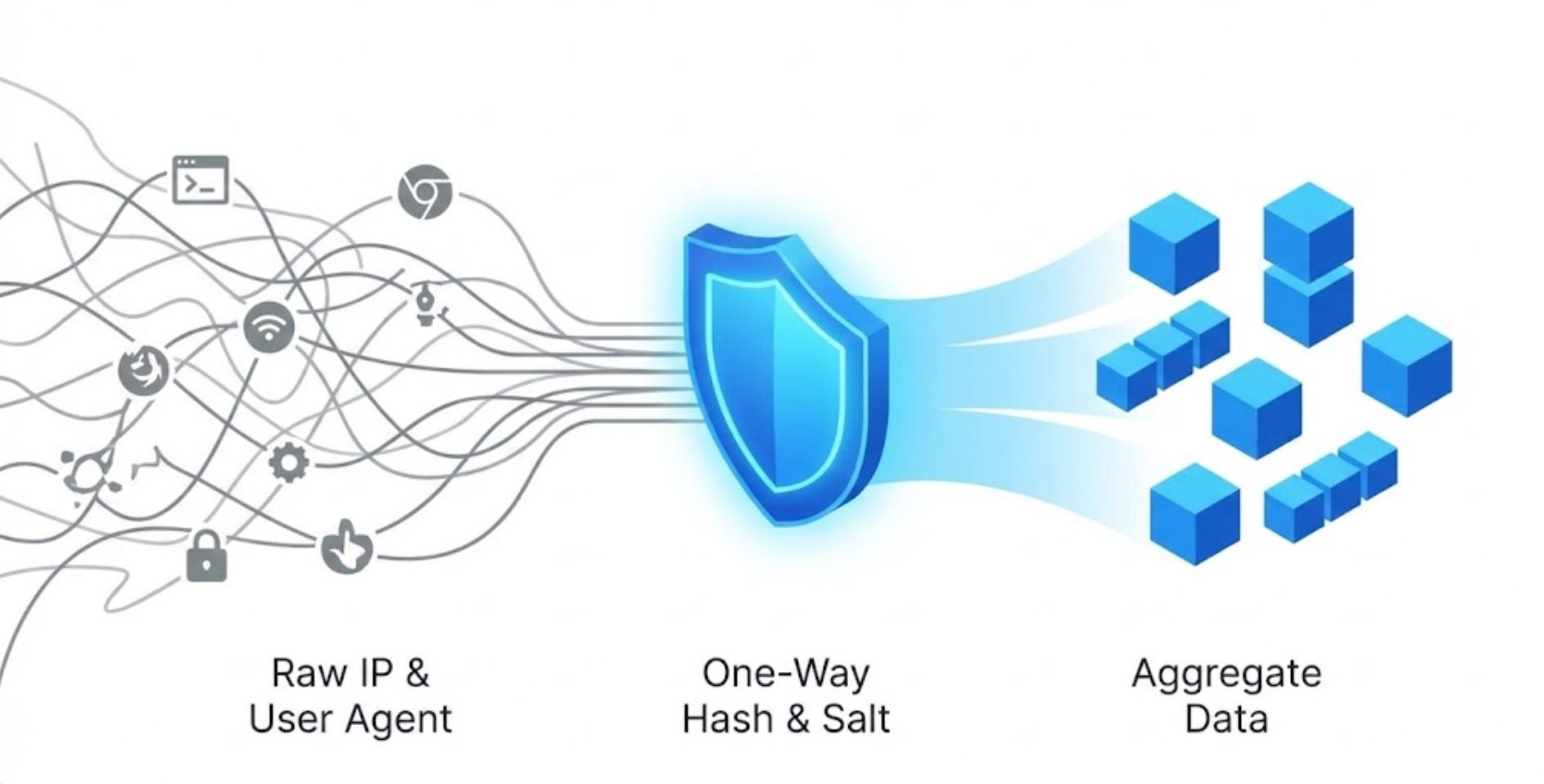
The mindset must shift from exploitation to service. Instead of asking how to harvest user data, we ask how we can give users value without collecting sensitive or personal information. The outcome is a system that is inherently harder to misuse. Compliance becomes automatic because the system collects very little to begin with. This builds strong user trust because the features are designed so that they inherently cannot violate privacy.
Web analytics has historically failed this standard. The industry relies on a persistent tracker often called an anonymousId. This is a UUID stored in a persistent cookie on your device. It tracks you across days and sessions to build a profile of your behavior over time. This method treats the user as a means to an end rather than a moral agent. It violates the principle of Contextual Integrity by allowing data to flow outside its appropriate social context. Under GDPR, this persistent tracking clearly requires consent because it intrudes on the user’s device and personal history.
VeritaMetrics takes a different approach based on the philosophy of digital ephemerality. We respect the right to be left alone by counting the visit without tracking the person. We replace the persistent tracker with an ephemeral visitId. This identifier is generated using a one-way cryptographic hash of the IP address, user agent, the date, and a rotating salt.
The salt rotates every 24 hours. This technical decision ensures that we cannot identify you tomorrow based on what you did today. The data expires. It is effectively firewalled by time. This aligns with the legal basis of Legitimate Interest because the processing is necessary for basic analytics but does not override the user’s fundamental rights or freedoms. We do not need a cookie banner because we do not intrude on the user’s device or long-term history.
We must be honest about the trade-off involved in this ethical stance. By removing the persistent cookie, we sacrifice Multi-Touch Attribution. We cannot tell you that a user saw an ad on Monday, returned on Wednesday, and bought a product on Friday. We accept this loss because the “perfect user journey” is often a myth.
Real life is messy. Consider a user who checks train times on a laptop during the day but buys the ticket on a phone app that evening. Traditional analytics can only link these distinct events through invasive cross-device fingerprinting or forced logins. The industry chases this level of tracking to close the gap, but the result is often just noisy data and broken trust. We stop chasing the individual and focus on the accuracy of the event.
We trade the fiction of the user journey for the reality of accurate, aggregate data. We restore the Contextual Integrity of the web. The shopkeeper has a legitimate interest in knowing how many people entered the store. That interest ends when the customer leaves. We count the visit. We do not follow you home.
We are looking for founders and product managers who value data accuracy and user dignity. If you want to test a platform that captures 99.5% of interactions without compromising privacy, message us on LinkedIn or send us an email. We will get you set up to use the features for free.