


The "AI Efficiency" Smokescreen
In 2025, the tech sector has seen significant job cuts, with trackers reporting figures ranging from over 80,000 to as high as 130,000. Companies often cite "AI efficiency" as a key reason. For profitable giants like Microsoft, these cuts seem to clash with strong earnings.
However, the trend is not uniform. It also includes firms facing significant financial pressure, such as Intel, which reported a net loss of $887 million for the first quarter of 2025 and is cutting jobs as part of a major cost-saving effort. This raises a crucial question: is AI a genuine driver of restructuring, or a convenient smokescreen for a complex mix of financial pressures and margin-boosting?
The timing of these layoffs is suspicious. Microsoft, for instance, saw its first-quarter 2025 revenue climb 13% to $70.1 billion but still cut over 15,000 jobs to "simplify operations and invest heavily in AI." This pattern is widespread. Intel is eliminating up to 25,000 jobs to cut $10 billion in costs, Amazon let go of 100 workers from its Wondery division despite strong earnings, and Google increased its AI funding while cutting its smart TV team by 25%.
Corporate jargon often obscures the true meaning behind these decisions. What companies call "business optimization" frequently means AI has replaced certain roles. Similarly, "restructuring" suggests that software can now perform the work, and a "focus on efficiency" signals that profit margins are being prioritized over jobs.
While most companies are vague, some have been explicit about AI's impact on headcount. IBM, for instance, has been open about replacing thousands of back-office roles with AI and automation. Similarly, the enterprise software firm ServiceNow reported saving $100 million in headcount costs through its own AI implementation. These cases show that direct job replacement is not a future hypothetical; it is already a factor in corporate budgeting.
Most companies, however, remain strategically silent, avoiding any explicit link between layoffs and AI. As one expert explained, admitting to AI-driven displacement can provoke negative reactions from employees, the public, and government regulators. Using vague terms helps preserve morale and manage the company's public image.
This smokescreen is effective for several reasons. Framing layoffs as a quest for "efficiency" sounds strategic rather than heartless. Investors applaud actions that improve profit margins. Furthermore, companies that avoid explicitly mentioning AI face lighter regulatory scrutiny, and using terms like "restructuring" is less damaging to employee morale than announcing that workers are being replaced by AI.
The statistics confirm a clear trend of workforce transformation. According to the World Economic Forum, 41% of companies intend to reduce their workforce in the next five years due to AI integration. This is not just a future intention; data from the U.S. Census Bureau shows that nearly 30% of businesses were already using AI to perform tasks previously done by employees in 2024. Projections from sources like Goldman Sachs, which estimates up to 300 million full-time jobs could be affected by automation, suggest this trend is set to accelerate significantly.
These figures confirm the trend is real, but they don't fully explain the motive. If AI's on-the-ground productivity is not yet a world-changing force, why are the layoffs so widespread? The answer lies less in current technological capability and more in strategic financial manoeuvring.
The primary audience for these announcements is not the public, but the stock market, which rewards the dual narrative of cost discipline and future-tech investment. The layoffs are less a reaction to proven efficiency and more a pre-emptive strike to free up billions in capital. This money is then funnelled into the incredibly expensive race for AI dominance, funding the specialised talent and computing power needed to compete. It is a high-stakes bet on the future, paid for by trimming the workforce of today.
The "AI efficiency" narrative provides political cover for what amounts to good old-fashioned labour cost reduction. Companies have every right to optimise operations, but the dishonesty of the narrative undermines trust and prevents honest conversations about managing this technological transition responsibly.
The AI Productivity Matrix
If you have ever wondered why a colleague finds AI coding tools indispensable while you find them frustrating, the reason is likely not your skill level but the nature of the work you are doing. Stanford researchers have found that the effectiveness of AI hinges on two key factors: the complexity of the task and the maturity of the project.
This relationship can be understood through the following productivity matrix.
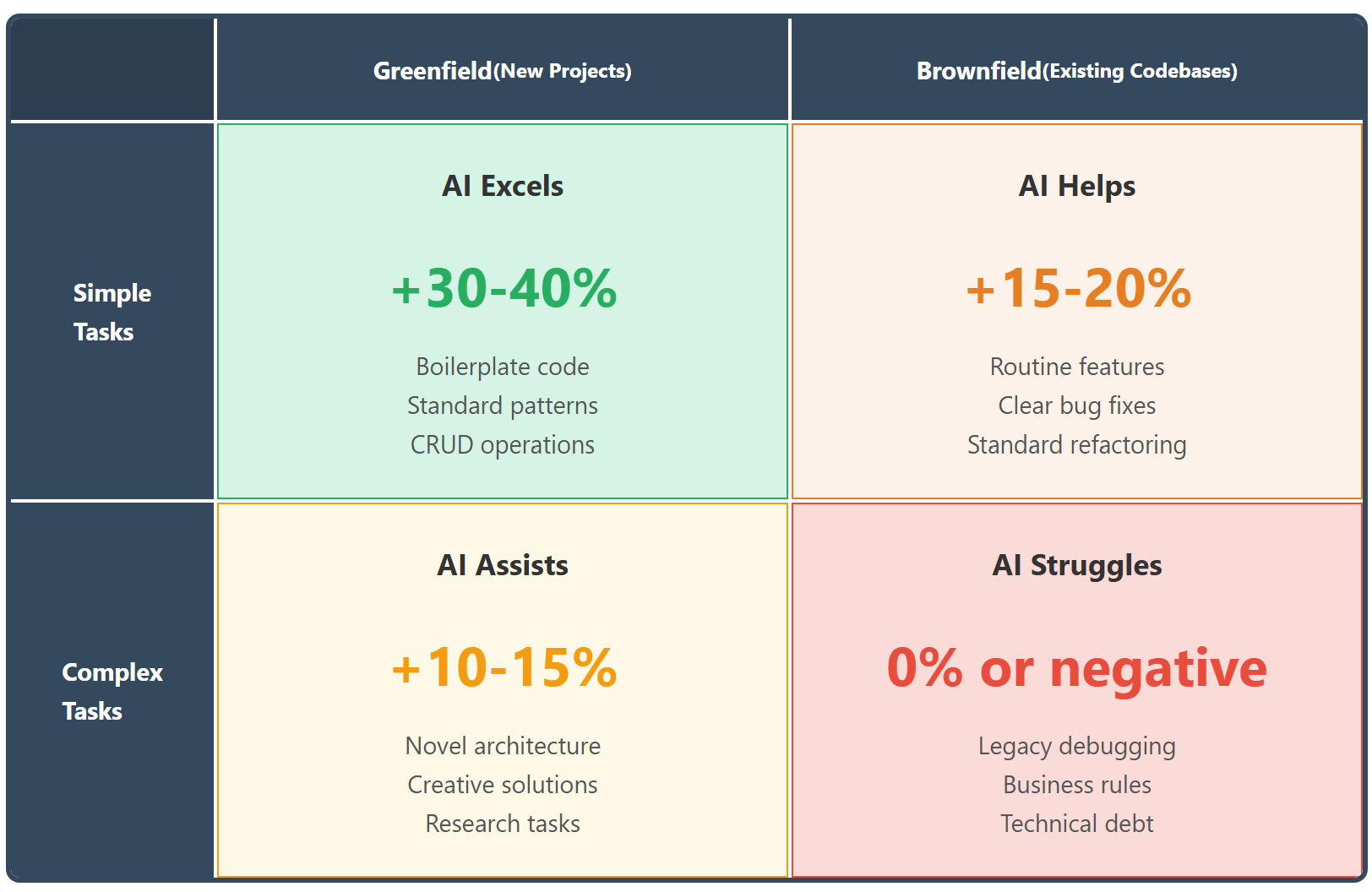
The highest gains, between 30% and 40%, are seen in what can be called the "green zone," which involves simple tasks on new projects. This includes writing boilerplate code from scratch, implementing well-known algorithms, or building basic applications like a new REST API. When the work on a new project is more complex, requiring novel architecture or domain-specific business logic, the productivity gains are more modest, typically between 10% and 15%.
The matrix looks different for work on existing, mature projects, often called "brownfield" development. For simple tasks within these established codebases, such as adding a standard feature or fixing a clear bug, AI can provide a 15% to 20% boost. However, the most challenging quadrant is the "red zone," which involves complex work in legacy systems. Tasks like debugging intricate business rules, navigating technical debt, or fixing a race condition often see productivity gains between 0% and 10%, and in many cases, AI can actually slow a developer down.
This distinction is crucial because most real work for experienced developers, often 60% to 80% of their time, occurs in this red zone. This explains the results of a METR study where 16 experienced developers working on large, mature open-source projects were 19% slower when using AI. They were operating in the quadrant where AI provides the least benefit.
Understanding this has strategic implications for developers, managers, and companies. Developers should use AI aggressively for new projects but remain sceptical of its value for complex debugging. Managers should not expect uniform productivity gains, as junior developers on new features will likely see greater benefits than senior developers maintaining legacy systems. For companies, this means the success of AI adoption will vary dramatically by team, and productivity should be measured by project type rather than with a single company-wide metric.
This framework also serves as a reality check. The "300% productivity gains" advertised in AI marketing materials are almost always measured in the ideal green zone. Your frustrating experience debugging a legacy system is the red zone, where AI can worsen the problem by generating plausible but incorrect solutions. The bottom line is that AI is a powerful amplifier for routine work on new projects. For the complex challenges within existing systems, where most experienced developers spend their time, its value is still mostly hype. Grasping this matrix can save you from both unrealistic expectations and unnecessary self-doubt.
AI Capabilities Reality Check
Despite breathless predictions that Artificial General Intelligence was just around the corner, a fact-check of those bold claims reveals a more modest reality.
The hype machine was running at full speed. Morgan Stanley, for example, forecasted that AI would add a staggering $16 trillion to stock market value, an estimate that assumed universal adoption across all sectors and rapid capability improvements. In reality, the conversation has shifted to a "massive investment cycle" that will play out over many years. That $16 trillion figure now looks more like a decades-long horizon than the quick transformation investors had anticipated.
Similarly, Leopold Aschenbrenner predicted that "by 2025/26, these machines will outpace many college graduates" and that by the end of the decade, "we will have superintelligence." Yet here in 2025, AI still struggles with reliability, often failing to solve logic tasks even when provably correct solutions exist, which limits its effectiveness in high-stakes situations where precision is critical.
The evolution of large language models tells a similar story. While GPT-3.5 was a revolutionary breakthrough that changed everything, GPT-4 delivered solid but incremental improvements like multimodality and a larger context window. The more recent release of GPT-5 was met with mixed reviews and did not represent another revolutionary leap in capability.
Instead of massive jumps in intelligence, the real progress is happening in efficiency. The cost of running models with GPT-3.5-level performance, known as inference cost, has dropped an incredible 280-fold. We are also seeing smaller, more efficient models achieving the performance of much larger ones, exemplified by innovations like Microsoft's Phi models and Qwen's algorithmic improvements.
At the same time, progress on performance benchmarks is beginning to plateau. The performance gap between the top models shrank from 11.9% to just 5.4% in a single year, with the top two models now separated by a mere 0.7%. This suggests we are hitting a point of diminishing returns from simply scaling up models.
What this all means is that while the AI revolution is certainly real, it is proceeding as a steady evolution rather than a sudden explosion. Meaningful progress is coming from better engineering, increased efficiency, and specialization, not from sudden leaps toward superintelligence. The key lesson for now is to plan for gradual, practical improvements in AI rather than holding your breath for science-fiction breakthroughs.
This slowdown in progress doesn't mean AI's impact will be small. Instead, it suggests we should analyse it not as a sci-fi intelligence, but as a general-purpose technology following a familiar historical pattern.
AI is the New Steam Engine
History may not repeat, but it often rhymes. Even if AI is not on an explosive path to superintelligence, its adoption as a general-purpose technology is following the disruptive playbook of the Industrial Revolution.
This pattern begins with the nature of the technology itself. The Industrial Revolution was driven by steam, mechanized production, and electricity, which powered a wide range of industries. Similarly, AI technologies like machine learning and LLMs are being applied across diverse sectors including healthcare, law, manufacturing, and finance.
Both revolutions create spill over effects that enable entirely new industries that no one could have predicted. This leads to a familiar economic dynamic: a surge in productivity accompanied by targeted job displacement. Just as factory owners grew rich while skilled handloom weavers lost their livelihoods, today's tech companies are realizing massive efficiency gains while some roles, like entry-level developers, face displacement. The short-term pain is often concentrated in specific sectors, while new opportunities emerge more slowly.
These revolutions also concentrate capital and reshape geography. The industrial era favoured the owners of factories and railroads, while the AI era favours firms with massive reserves of data, computing resources, and talent, creating extreme inequality in both periods. This clustering of wealth and jobs also leads to geographic reshuffling. The Industrial Revolution drove urbanization and migration to factory towns, just as AI is now concentrating talent in tech hubs and enabling new remote work centres, leaving some regions behind.
A final parallel is the significant lag in institutional response. Critical societal structures like labour laws, public health systems, and modern education came only after the social upheaval of industrialization. Likewise, today we are debating AI regulation, safety standards, and retraining programs while the technology is being deployed at a rapid pace, showing that policy consistently trails technological advancement by years or even decades.
However, there are important differences. AI is spreading globally in days, a stark contrast to the decades it took for industrial machinery to disseminate. Furthermore, AI primarily transforms information and decision-making, whereas the earlier revolution transformed physical production. AI also has a unique dependency on massive datasets and network effects, which introduces new risks of concentration.
The historical lesson is clear: the benefits of the Industrial Revolution took decades to be widely felt and came at a tremendous human cost. We can learn from this by implementing early, targeted policies and encouraging civic engagement to reduce harm and accelerate shared prosperity. At the same time, AI presents new risks like mass surveillance, misinformation, and algorithmic bias that do not have a direct historical precedent.
The bottom line is that we should treat AI as another sweeping technological revolution. We must harness its productivity gains while simultaneously investing in our institutions, education, and governance now, ensuring this transition is far less brutal than the one in the 1800s.
The Kasparov Chess Lesson
Twenty-seven years ago, Garry Kasparov demonstrated a profound understanding of AI collaboration. After his famous loss to IBM's Deep Blue computer in 1997, Kasparov did not retreat. Instead, he pioneered a revolutionary concept.
Just one year later, he introduced "Advanced Chess," a format where humans play with the assistance of computers. He put this idea into practice by using a supercomputer to win a match in Spain, allowing the machine to manage complex calculations while he concentrated on overarching strategy. This led to what is now known as "Kasparov's Law," the principle that an average human working in harmony with an AI system is more effective than either working alone. The law further suggests this partnership is even more advantageous than a brilliant human collaborating poorly with a system.
From Deep Thinking: Where Machine Intelligence Ends and Human Creativity Begins by Garry Kasparov:
A clever process beat superior knowledge and superior technology. It didn’t render knowledge and technology obsolete, of course, but it illustrated the power of efficiency and coordination to dramatically improve results. I represented my conclusion like this: weak human + machine + better process was superior to a strong computer alone and, more remarkably, superior to a strong human + machine + inferior process.
The modern state of chess provides a fascinating validation of his point. Today's chess engines are rated over 3400 ELO, a level that completely dominates the peak human rating of 2882 achieved by Magnus Carlsen. While machines are now supreme in competitive chess, the crucial insight is that any amateur can now play brilliant chess by using an engine. The tool has democratized a level of expertise that once required decades of dedicated study.
This lesson is highly relevant to our current relationship with AI. Kasparov reframed the dynamic from "man versus machine" to "man with machine," a concept he called "augmented intelligence." He realized that humans provide intuition, creativity, and strategic thinking, while AI excels at computation, pattern recognition, and processing vast amounts of data. When combined, their capabilities far exceed what either could accomplish separately.
This has a clear parallel in the modern world. While many companies worry about AI "taking jobs," the true opportunity lies in collaboration. Kasparov suggests our role is to become "shepherds" who guide the "flock of intelligent algorithms" toward productive outcomes. His prediction from 1998 is now evident everywhere, from AI-assisted software development and medical diagnostics to creative endeavours. The ultimate lesson is that we should stop fighting against AI and instead learn to partner with it effectively.
Before the rise of chess engines, achieving the rank of grandmaster was a monumental task that required decades of intense study. Aspiring players would dedicate countless hours to analysing positions on physical chessboards, memorizing complex opening variations, and poring over dusty chess literature.
Today, that landscape has been completely transformed. As Garry Kasparov himself observed, any amateur can now "put the position in any chess engine and wait for a few seconds and know who's winning and what strategy to follow." This shift is staggering. In the pre-1997 era, grandmasters spent years developing the skill to evaluate positions, and access to high-level analysis was often limited to those who could afford expensive private coaches, with deep chess knowledge concentrated within elite circles. Now, anyone can have instant access to analysis far stronger than any human has ever produced, often through free engines like Stockfish that run on a simple smartphone. This has led to prodigies like the youngest grandmaster in history, Abhimanyu Mishra, achieving milestones in their early teens that once took decades, having been trained with chess tutors "orders of magnitude more powerful than Deep Blue" from a very young age.
However, this technological leap created a paradox. Instead of making the game of chess stale or boring, engines have fostered greater creativity. Google's AlphaZero, for example, discovered sacrificial and aggressive styles of play that were more reminiscent of Kasparov's own dynamic approach than the cautious, mechanical style that was expected from computers. This new approach even inspired the world's top players; Magnus Carlsen studied AlphaZero's games and noted that he "discovered certain elements of the game, certain connections" that he might not have found otherwise.
The parallel has limits. A chess engine provides the truth because it calculates the objectively best move better than any human. By contrast, language models don’t generate probabilities, predicting likely continuations without guaranteeing correctness.
In chess, a weak player often hinders a strong engine by adding noise to the calculation, while a strong player guides the engine and filters its suggestions using intuition and experience. Similarly in programming, LLMs and code completion tools help beginners with syntax, but they do not supply engineering judgment. An inexperienced programmer cannot evaluate and improve flawed code. Only an experienced engineer can filter mistakes, understands architecture, guide the tool, and know when to override it.
Code completion tools do not eliminate programmers. They help beginners translate ideas into software. They remove syntax barriers but don’t teach architectural foresight or debugging instincts. These skills require years of practice.
Similarly, writing assistants do not replace writers but help people produce coherent prose. They do not grant the intuition of an experienced author. Advanced design tools allow anyone to create layouts but they might miss the context and they still lack controllability. They do not replicate a designer’s ability to balance usability and intent. AI democratises creation but doesn’t compress expertise. It accelerates novices. It does not equalise them with experts.
AI is a multiplier but it does not equalise skill. AI raises the floor for beginners, but it raises the ceiling for experts even higher. The stronger the human, the more powerful the team.
The real lesson from this evolution is that when powerful tools become widely accessible, the baseline of human capability rises dramatically. The critical question is not whether AI will make experts obsolete, but rather whether you will leverage these tools to become superhuman at what you do. Understanding the hype, the reality of its limitations, and the historical parallels is the first step in learning to work with the machine, not be replaced by it.
Updated August 20, 2025 to add Kasparov’s exact quote to state Kasparov’s law.
Updated December 7, 2025 to clarify that a junior programmer + LLM do not equal a senior developer’s expertise. Thanks to Ian Ozsvald for insightful feedback.
Don't expect uniform productivity gains from AI across teams. You should measure impact by project type, not company-wide averages.
Do you want to build production systems that actually work? My book covers what really happens when AI meets reality: amzn.to/4dErkya. You might also want to see the Chelsea AI website for bespoke AI development and Akilima’s description of a few AI data products we are building.