


The internet has a problem. There’s a flood of low-quality, machine-generated text that now fills search results. It is grammatically correct. It is also boring, repetitive, and obviously fake. Users are learning to spot it instantly. They hate it and when they see it on your website, they leave.
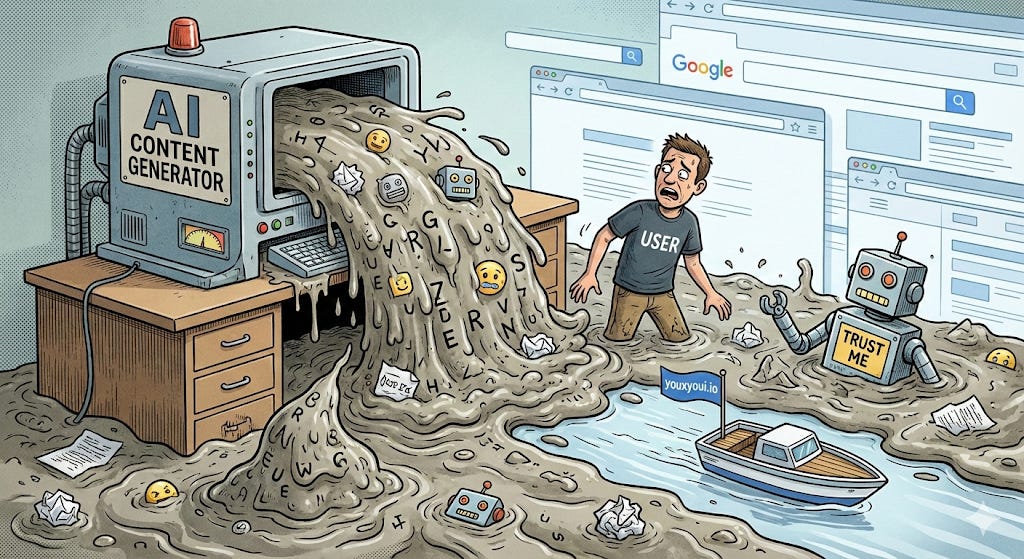
[admittedly this image is AI generated — I hope you can forgive us this once]
AI service companies want to sell you automation tools that replace humans completely but in the age of AI content, there’s even more value in the human connection and human creativity.
The difference between human content and AI content is a measurable financial risk. Research shows that human-written content scores 79% on trust. AI-generated content scores only 12% [1].
This is a massive deficit. Users describe human content as authentic and credible. In contrast, they describe AI content as robotic. Is your “About Us” page automatically written or did you bother to write it yourself? If your product description sounds robotic, you lose the customer.
A recent study (and there are many similar ones) shows that a significant part of consumers, roughly half, can correctly identify an AI written copy [2].
How youxyoui Solves This
We built youxyoui.io to function as an objective auditor. It analyzes your site for usability and trust. We developed a specific “Trust Module” to fight the slop.
The system assigns a “Human Probability Score” to your content blocks. It flags high-risk areas like testimonials or bios. If your CEO’s biography sounds like a chatbot wrote it, the tool will tell you.
There’s more. There is a persistent myth that big words make you sound smart. They do not. They make you sound like you are hiding something.
Our “Clarity Module” scans for jargon. It flags sentences that are too long. It highlights “difficult words” (three syllables or more) that lower conversion rates. It forces you to write simply.
Users look for visual proof of safety. They look for security badges and third-party reviews. Our tool scans your DOM (the code structure of your page). It checks for trust seal fingerprints and looks for review widgets. It calculates a “Trust Score” based on these signals and the human quality of your text.
Trust Is Revenue
This is directly addressing the user’s subconscious fear of fraud or poor service. If a user suspects your site is fake or automated, they will not enter their credit card number. Adding valid trust signals can increase conversion rates by up to 42% [3].
youxyoui.io gives you the data to fix this. It helps you remove the “slop” and restore the human connection. It’s built with models and incorporates best practices around web design with deep AI models at Chelsea AI Ventures.