


We are deep in an AI Hype Cycle. The potential for AI to automate human labour is a subject of profound societal interest and concern. We constantly hear claims about AI’s rapid progress on complex reasoning benchmarks, which has fuelled a narrative that a new wave of “agentic AI” is ready to automate large parts of the workforce.
But how do these claims hold up against real, complex, economically valuable work?
A new study provides a sobering, empirical answer. The Remote Labor Index (RLI) study about automation was conducted by researchers from the Center for AI Safety and Scale AI, a nonprofit organization based in San Francisco that conducts technical research and creates foundational benchmarks to identify and mitigate AI risks.
This is not just another benchmark of simplified toy tasks. The RLI is designed to measure “end-to-end agent performance in practical settings” (quote from the paper). It is composed of 240 real-world, economically valuable projects sourced directly from online freelance platforms.
The projects in the RLI are complex, with a mean human completion time of 28.9 hours. The benchmark is multi-sector and includes projects from 23 different work categories, including:
Video & Animation
3D Modeling & CAD
Graphic & Editorial Design
Audio & Music Production
Building & Landscape Architecture
Game Design & Development
Web Development
Data Analysis & Testing
Data Extraction/ETL
Management Consulting & Analysis
Corporate & Contract Law
Translation & Localization Services
Market Research & Product Reviews
How AI Was Tested Against Real Work
The study evaluated six state-of-the-art AI agents: Gemini 2.5 Pro, ChatGPT agent, GPT-5, Sonnet 4.5, Grok 4, and Manus.
To complete the projects, researchers used several “agent scaffolds”, by which they mean systems, tools, and environments that an AI model (like GPT-5) uses to perform a project. These included:
Integrated agents like ChatGPT agent and Manus.
A Computer-Use Agent (CUA) environment, which allows the AI to use a mouse, keyboard, and file editors.
A Command Line Interface (CLI) environment, where the AI works through text-based commands.
Success was measured using the “Automation Rate”. This rate is not a measure of partial completion. It is the percentage of projects where the AI’s final deliverable was judged by human evaluators to be at least as good as the “human deliverable” (a gold-standard version produced by a professional). In other words, Automation Rate is about working like a human professional.
The core test was simple: Would a “reasonable client” accept the AI’s output as the commissioned work?
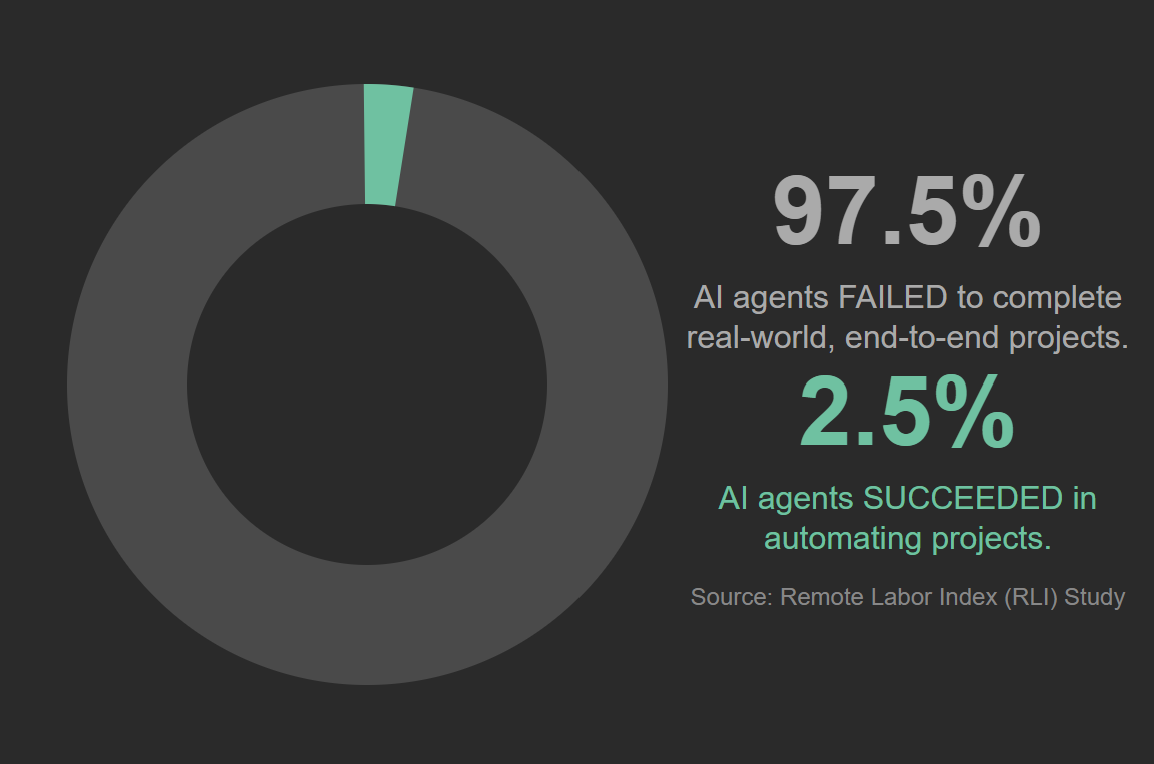
2.5% Success Rate
The study’s central finding is that “AI agents perform near the floor on RLI”.
The highest automation rate achieved by any agent was just 2.5%.
Other frontier models also struggled. Grok 4 and Sonnet 4.5 achieved a 2.1% rate, GPT-5 (CLI) hit 1.7%, and Gemini 2.5 Pro was at 0.8%.
The qualitative analysis reveals why the AI agents failed. Deliverables were frequently rejected for basic, systematic failures. Of all the AI-generated deliverables:
45.6% were rejected for “Poor quality”. Examples included “child-like drawings,” “inconsistent visual appearance across renderings,” and “robotic or unnatural voice-overs”.
35.7% were “Incomplete”, such as “missing components” or “truncated videos”.
17.6% had “Technical and File Integrity Issues,” like producing “corrupt or empty files”.
The few successes were “predominantly creative projects”. These included audio editing and mixing, image-generation tasks like creating logos or ads, and writing code for simple, interactive data visualizations.
What This Means for Industry Claims
The RLI study provides powerful, empirical data that grounds the AI hype. This data strongly supports the fact that 95% of generative AI pilots fail to deliver P&L impact.
Real-world business value isn’t about generating plausible-sounding text, a phenomenon we call AI slop. It is about delivering complete, high-quality, technically-sound, multi-file projects that meet a client’s specific business requirements.
The RLI paper shows that before you invest in a massive automation initiative, you must start with a validation-first approach. This means using a time-boxed Proof of Concept (PoC) to test the technology against your specific, complex business problems.
You can’t expect simply to buy an “AI employee” off the shelf and expect it to work. The only rational path is to de-risk new technology. At Chelsea AI Ventures this is the core of our ROI & Validation-First Mandate.