



We’ve all been witnessing the rise of powerful chatbots that shocked all of us with this spark of language that we thought only humans are capable of and there was a lot to learn and to catch up on. One of the most powerful things however was to learn about human value in the world and about things that you can’t automate.
The Limits of Automation and Human Value
I was working in research and then for more than a decade in automating different kind of processes in companies from credit scoring systems, HR systems, to recommendation systems, and marketing acquisition and all kind of things from internal to external-facing processes. It’s ironic that I’m sitting here and I’m writing there are things you just shouldn’t automate or can’t.
There’s been so much talk about software development. We’ve all heard CEO of major companies saying the cost of software is coming down to infrastructure costs, and that software developers are not needed anymore, because coding is solved. Companies are trying to automate everything with AI agents, especially the ones selling them. Salesforce got rid of about 4,000 people and they are slowly coming to the realisation you can’t really automate everything. The talk is they’re trying to hire back these people without losing their face now.
There are different ways of expressing why it’s not possible really to automate everything. But really the most intuitive way to put it is that it comes down to the human value and the context. You can express it in terms of embeddedness — you need to be part of the world really to understand it fully, and AI agents are just not at this point yet, they don’t have the context nor the full experience of the world. But it also really comes down to creating meaning. And meaning can only be in terms of human relationships and how something relates to the world. And that’s something that is just missing in AI agents, it is human. Alternatively, you could say there’s a concept drift or there are exponential failure rates in terms of the complexity of processes. We’ve all been experiencing it in multi-turn conversations in a chatbot, and the same is happening in agents.
There are different ways of expressing this but it comes down to limits in automation.
AI as a Personal Tool
There are many great aspects of these new AI systems. One is for writing emails and if you are not sure “Can I really say that?” and “Is that right?” And I’m really prevaricating and can’t send it out. And then I just put it into the chatbot, get some feedback, and yeah, “Okay, it’s okay.” I can send it off. It can help so much, especially anyone who’s struggling with social anxiety.
For people struggling with ADD or ADHD, they’d switch between hyper-attentive and hypo-attentive so either they talk way too fast or really struggle with the speed of information coming in. It’s extremely difficult to regulate that and these chatbots can help a lot, at least in the written communication, to maintain some kind of reasonable level of performance or of kind of working through some of these challenges, helping through troughs and but also helping sometimes reaching new levels.
The biggest thing really in these chat systems—and that’s something that has not really been explored that much, at least I haven’t seen it talked about that much—is really education and learning. And it’s using these systems to help you learn.
It’s a fulfilment of everybody’s dream perhaps. Your own personal coach, available 24/7, for free? How amazing is that? You get a personal instructor that can help you learn any subject really, or lots of different subjects. If you use it the right way, you learn so fast and you can do many, many great things. But how do you use it, where’s the instruction manual?
Here are my rules of engagement or my brain rules for using AI, the 10 commandments of AI, if you like.
The MIT Study and Brain Rules
There is a clear line between support and replacement. Cognitive scaffolding helps a person reach a higher level of understanding. It provides a structure for the learner while the learner performs the hard work of thinking. Cognitive offloading occurs when a person outsources the thinking process to a machine.
There was a recent study by MIT about people, more than 50 students, who were using chatbots to do certain tasks. And some people were not using chatbots but instead they were just doing them themselves. And there was an intermediate group as well.
The study showed showed that the more people relied on chatbots, letting the chatbot do the work, the less they retained any information and the less brain activation the participants had (using EEG). The lowered brain activity was particularly in the dorsolateral prefrontal cortex, an area that’s related to working memory, to decision making, and executive function.
There are long-term effects from relying too much on these systems because your brain adapts. “Use it or lose it” they say in neuroscience. By offloading the cognitive work to the AI, you become a quality controller and — in the long-term — you lose the capacity really to think on your own, to reason, to make decisions, and so on.
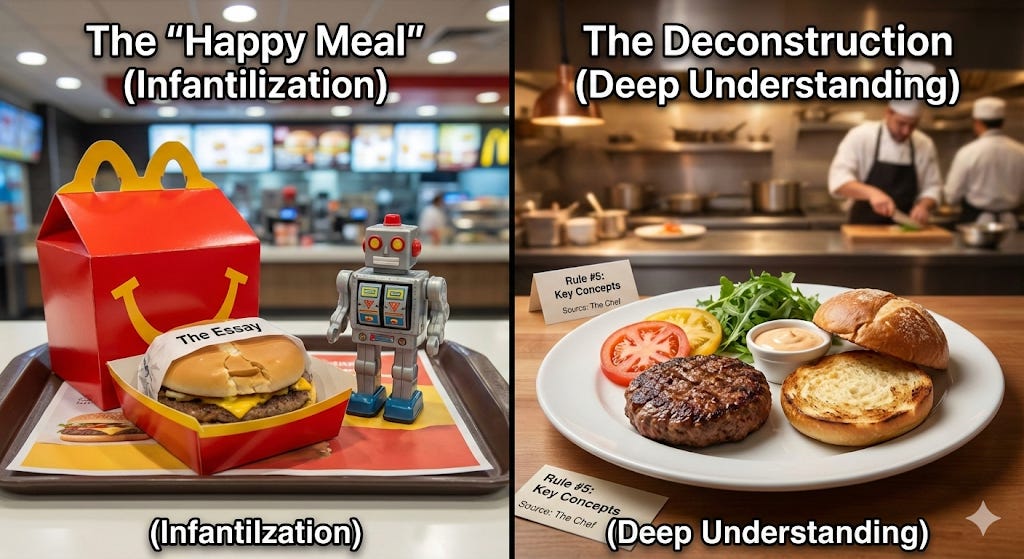
In our last article we’ve talked about removing the brain drain when using AI tools but we can actually give more concrete rules about how to engage with AI chatbots, where you use AI as the helpful assistant it should be, which helps you with information and tips, and you are the creator and architect. So here are my my brain rules for AI as promised that can give you the Chef Menu instead of the Happy Meal.
The 10 Brain Rules for AI
Rule 1: It’s either fast or it’s learning. You can’t have both.
You can have the McDonald’s menu, you can get the research report very quickly. But it will be “one size fits all,” it will be boring, monotonic, and have lots of em-dashes. And probably not a lot of good detail in there. And nothing specific to your particular context.
The other option is learning. So if you use it in a certain way, then you learn a lot.
And, hopefully, I can show that you can get a much better research report or whatever your are trying to create—by digging down into the details and putting some more of yourself in, working collaboratively, and getting the Michelin star research report instead.
Rule 2: Request friction. Ask for cues.
Attempting to answer a question before learning the answer activates relevant neural networks. This is also about adjusting the difficulty level. You can dig in more, you can get more details, or you can zoom out a bit, more to general principles or go really into the technical depth of things. But the most important thing is really that you do active retrieval. Instead of just getting the results already, you ask for cues to help you remember. So you come up with the information. Friction aids memory by activating your brain.
For language learning, some people used to tell me it’s much better to have a physical dictionary because then you have to look it up and you spend some time, you leaf through the pages and you find the word you didn’t know It’s agonisingly slow, especially if you are interested in what you are reading, or you are in a rush. This friction is good, people were arguing, because it helps you remember.
AI can help you reduce friction but you can choose what kind of friction you want reduced. There are different kinds of friction. There’s a logistical friction which is good to remove. And there is a cognitive friction which you want to maintain. I’d argue that removing the physical dictionary lookup is probably a good thing to do, because it’s logistical friction, and you can instead focus on the text and understanding the language.
Rule 3: Explain your reasoning.
The situation with chatbots today is similar to the introduction of Wikipedia. Chatbots help you retrieve information extremely quickly and both Wikipedia and Chatbots are unreliable to some degree — as is any source if we are being honest. But one principle in Wikipedia—anybody who’s contributed should know it—is “cite your sources.” You can go through a Wikipedia article ask critical questions and be able to go through the source material to verify any claim.
They same principle should hold for chatbots. You should ask them really to come up with the references but also to explain the reasoning. Ask critical questions: “so why is this like this? Why do you think this is the case?”
You will have to present it or you make decisions based the material so it’s very important to be able to understand and then be able to interrogate and revise any decision.
Rule 4: Pre-test.
So you are starting with your research report, let’s say. And the first question you should ask yourself is “what do I know about this?”
You can do it by yourself. It maybe only takes 30 seconds. “What do I know about the subject? What is important?”
You can go wide first, do a sweep of different concepts, then maybe “this is the most important thing because this...” and then you go down to more details.
You can ask the chatbot to ask you probing questions as well. If the chatbot is quizzing you, you know where you stand.
Rule 5: Learn the key concepts.
This is where we can apply the 80/20. Most skills follow a power law. A small set of sub-skills delivers the majority of the performance. Use the AI to break complex domains into atomic parts. Ask it to identify the top concepts that allow you to solve practical problems. Demand it explain why those skills are the most important.
We can even compare this to the ideas from “20 hours to learn anything”, a book by Josh Kaufman. He was talking about him learning the ukulele in 20 hours and giving a concert on stage for a TED presentation as his 20th hour. The main idea of his approach was focusing on the most important skills needed — in the case of the ukulele it was about the chords in order to play particular songs.
When you learn the key concepts you go into some detail such as why they’re important, how they’re important, how you’d visualise them, how we use them and so on.
Rule 6: Iterate and chunk.
The brain can only process a few new concepts at once otherwise it gets overloaded. Your working memory can only hold a few items at any point in time when you are thinking about a topic. Therefore, breaking complex topics into small turns allows for proper encoding. You have to break down the information into chunks.
You have to enforce a stop-and-go structure and go one by one and you have to convert the information into pieces that fit into your memory. It’s worth to emphasise this point: when you are thinking or reasoning you can only hold few items in memory. Any time you want to think about the connection to any other item that’s not in memory you have to load it first. This means you have to remove another item to make space, unless you manage to come up with a concept connecting the existing items in which case you need less space.
The original paper by by Alan Baddeley and Graham Hitch from 1974 about working memory came up with the magical number, the capacity of 7 +/- 2 chunks (depending on people and situation). Subsequent research has revised the number and lowered it down to around 3 to 5 pieces of information. Whatever the exact number, working memory is very limited. While you reason, you have to continuously swap out elements making it hard work. If your reasoning involves a lot of concepts and details that you have to understand you are risking cognitive overload.
On the flip side, if you let the chatbot generate everything for you, you have to read it, and your working memory processes parts of sentences at a time. While reading you are tempted to think you understand what you are reading (fluency illusion) but it’s easy to skip, not consolidate the information, and forget.
Rule 7: Test again.
You’ve learned your key concepts, you’ve been coached a bit by the AI. At this point, we have to ask or better actively test ourselves what we have retained and understood. True learning happens when you pull information out of your brain. Active recall strengthens the neural pathways in the hippocampus.
It’s important also to think about the timing there. Forcing a recall session around 20 minutes after learning the concepts could be ideal. You can ask the AI to quiz you on the material.
Rule 8: Coach the AI.
By becoming the teacher you have to think about the key concepts, broader perspective, and connections. Explaining a concept forces you to organise information coherently. It reveals gaps in your understanding immediately and you put yourself in this active role again.
Rule 9: Ask for feedback.
You can ask yourself what you’ve done, how you could have better, or what you still need to learn. What was not as good as it could have been? Reflecting on errors activates the dorsolateral prefrontal cortex, the brain area which handles executive control.
You can tell the AI to give you constructive feedback when it’s criticising you if it makes it easier.
Rule 10: Do your dishes.
Memory needs time to consolidate. You have to give yourself and your memory some time. You can do your dishes, you can make a coffee, do your laundry. You shouldn’t flood your memory with new information directly. Don’t sit on your sofa watching YouTube.
Even better, writing by hand or thinking in silence switches the brain to synthesis mode. You have to physically step away from your device to process the information.
Bonus rule: Talk to humans.
While it can be fun and even useful to talk to AI, and you can get a lot of feedback from a chatbot, in the end, it’s really humans that give meaning to the world and that establish your belong to it. Only by talking to humans, you can see kind of where you’re going with your work (the report, for example), and if there’s any meaning in what you’re doing.
In summary, passive use can lead to cognitive offloading where the brain does less work. This results in weaker encoding of information. Active protocols ensure the machine increases human ability without replacing human thought.
By introducing friction, making the experience active and engaging, you not only learn a bunch while having fun, but you change your role in the interaction with the AI: instead of drive-thru consumer you become the chef, and the result can become a top restaurant experience instead of a greasy burger. Use cognitive scaffolding instead of cognitive offloading!
If you are interested in the prompts you can use for this approach, send us an email or contact us at Chelsea AI Ventures. We also offer a prompting course to groups with size of a minimum of three people.